


Did you know 77% of patients use search engines before booking an appointment? Your medical content optimisation strategy determines whether they find your practice or your competitor’s. Search engines start 81% of healthcare experiences. This makes healthcare website content SEO essential for patient acquisition. Many medical practices still struggle with visibility. A detailed healthcare content strategy becomes critical here. Optimising medical service pages, treatment page SEO optimisation, and patient education SEO content are key components of effective healthcare digital marketing services that help practices improve search rankings and patient participation. This piece will show you exactly how to boost your healthcare website’s visibility through proven optimisation techniques.

The Current State of Healthcare Website Visibility
Medical practices face an unprecedented visibility crisis. The strategies that worked two years ago no longer guarantee patient reach. Search algorithms have evolved beyond keyword matching. AI-powered systems now determine which healthcare providers appear in patient searches.
Why Traditional SEO Approaches Fail for Medical Content
Traditional SEO tactics centred on keyword density, backlinks and blog posts. These methods now produce diminishing returns for medical websites. AI-native search interfaces like ChatGPT, Gemini and Claude have become research tools that patients use first. The entire foundation of medical visibility has moved. These large language models don’t crawl websites the way Google does. They map meaning through structured entity relationships. Patients ask AI systems about treatments or providers. The responses come from internal indexes of trusted medical entities, not from keyword-optimised blog archives. Your practice might still rank on Google, but you’ve disappeared from the systems that influence patient decisions.
Healthcare SEO also operates under stricter constraints compared to other industries. Medical content must follow advertising laws and privacy standards. Any claim about treatments requires clinical backing. This slows content production and limits keyword flexibility. Writers must work together with certified experts, which extends review cycles. General businesses can publish content fast. Medical practices face constant compliance checks that delay updates. Page load speed creates another barrier. Patients abandon sites that take longer than three seconds to load. Yet average healthcare website load times reach 8.66 seconds. This technical gap alone costs practices patient traffic before content quality even matters.
Competition from Major Health Publishers
Small clinics and independent practices compete against health networks with deep resources. Major medical publishers maintain a strong domain authority built over the years. These platforms employ large content teams and possess deep backlink profiles that newer practices cannot match as quickly. Paid advertisements dominate top search positions and push organic medical results further down the page. Many healthcare websites target the same medical terms and patient questions, which raises keyword difficulty. Urban areas intensify this competition for local search visibility. Multiple providers fight for the same geographic patient base.
How Patients Search for Healthcare Information
Over 70,000 healthcare searches occur every minute. More than 60% of consumers use the internet to select new providers or research care options. 92% of patients rely on Google as their search engine. Patient behaviour reveals surprising patterns. 59% of those researching health information online never discuss their findings with doctors. Another 57% use online searches to verify advice already received from physicians. This indicates patients seek supplemental understanding rather than replacement guidance.
Search intent varies by patient education and income level. Internet use for medical information is associated with age under 60 years, college education and higher household income, these demographics shape which patients find your practice through organic search versus other channels. Patients evaluate multiple information sources before deciding. Healthcare organisation websites serve as the research destination that patients visit first. Most patients also consult health content sites and third-party provider listings. Reviews carry exceptional weight. 85% of patients trust online reviews as much as personal recommendations. The average provider rating influences both new patient attraction and existing patient loyalty.
Foundation: Healthcare Website Content SEO Essentials
Effective content optimisation begins with thorough healthcare SEO keyword research understanding exactly what language patients use before you structure a single page. Each optimisation layer works together to signal credibility to search engines while serving patient information needs.
On-Page SEO Elements for Medical Websites
Title tags represent the most critical on-page element for medical websites. 36% of SEO professionals think about them as the most important factor. Page titles containing 6-13 words generate the most traffic. Each medical service page needs a unique, descriptive title that has relevant keywords near the beginning while staying under 60 characters to display correctly in search results. Meta descriptions serve as concise summaries appearing beneath titles in search results. 43% of users click on search results based solely on the meta description. Keep descriptions between 155-160 characters, place primary keywords near the beginning, and add clear calls to action like “Schedule an appointment” or “Learn more.”
Header tags create a content hierarchy that guides both patients and search algorithms. Reserve H1 tags for main page titles, then use H2 and H3 tags to organise subtopics and sections. Strategic header placement that mirrors patient questions can increase incoming web traffic. Search engines analyse URLs, metadata, headings, and body text to understand page content. Proper header structure becomes vital for boosted indexing.
Alt tags describe images in HTML code and provide text alternatives that help search engines index visual content correctly. Failing to add descriptive alt tags negatively affects search rankings. To name just one example, instead of “doctor-image-1.jpg,” use “cardiologist-performing-echocardiogram-exam.” Internal linking connects related medical topics and helps search engines understand site structure while improving crawlability and ranking. Schema markup transforms unstructured data into structured information through code added to HTML. Healthcare content using FAQ, How-To, MedicalCondition, and Speakable schema is 2X more likely to surface in AI Overviews.
Writing Content That Meets Medical Guidelines
Medical content falls under Google’s Your Money or Your Life guidelines, which involve strict standards due to potential effects on individual well-being. Healthcare website content SEO must demonstrate E-E-A-T: Experience, Expertise, Authoritativeness, and Trustworthiness. Content written with ground medical knowledge from practising physicians receives priority. Add author bios with credentials on every medical article, such as “Dr John Doe, 15+ years in cardiology”. This establishes expertise and builds patient confidence. So pages showing verified physician bios plus institutional endorsements receive prioritisation from search algorithms.
AI-generated health marketing claims now face scrutiny from the FTC and FDA. Healthcare brands must disclose when AI tools contribute to patient-facing content. Add a “This Content Reviewed By” physician badge plus an AI disclosure note beneath every page to boost patient trust and ensure compliance transparency. Content optimisation represents one component of broader healthcare digital marketing services that help medical practices improve search visibility and patient engagement through strategic implementation.
Optimising URLs and Site Architecture
Siloing creates an SEO technique where you group, isolate, and interlink content about specific topics. This approach helps guide users and search engines throughout your website clearly while helping search engines crawl, index, and rank pages better. Craft clean, readable URLs incorporating relevant keywords that reflect page content. Avoid lengthy or cryptic URLs and use hyphens to separate words instead of underscores or spaces.
Mobile-First Content Design
Google uses mobile-first indexing and evaluates the mobile version of websites before the desktop versions. Sites not available on mobile will not be indexed or ranked at all. 97% of Americans own cellphones, and almost 60% of global website traffic comes from mobile devices. Responsive design becomes mandatory. Mobile optimisation requires text large enough to read without zooming, touch-friendly buttons spaced well for navigation, and pages loading under three seconds. Compress images without sacrificing quality, reduce file sizes, and simplify code to improve loading speeds. Ensure appointment forms contain minimal fields and position call-to-action buttons with click-to-call functionality. Mobile optimisation and fast page load times are not just content decisions, they’re covered in depth under technical SEO for healthcare websites, which underpins everything your content tries to achieve.
Creating High-Performing Treatment Page Content
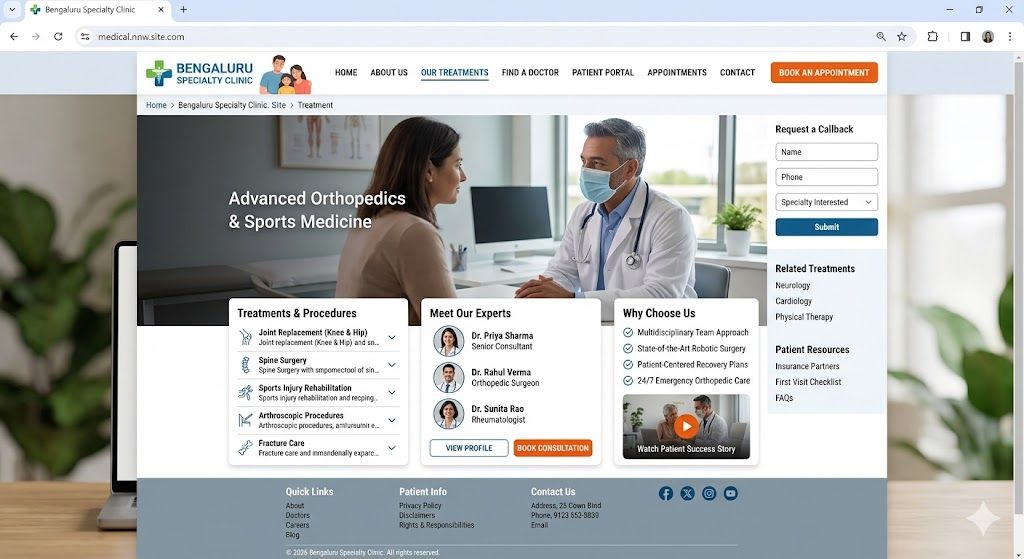
Treatment pages convert browsers into patients when structured around specific search behaviours and decision triggers. Effective treatment page SEO optimisation addresses patient intent at multiple trip stages and builds trust through strategic content elements.
Understanding Patient Search Intent
Patients move through three distinct stages when researching healthcare options. They experience symptoms but lack diagnosis clarity during the awareness stage. They search terms like “sharp knee pain when walking”. Symptom explainer content and condition education serve their needs at this point. The consideration stage follows once patients understand their condition and begin evaluating treatment approaches. They compare options through searches like “CPAP vs. oral appliances for sleep apnea”. Decision-stage patients actively select providers and focus on credentials, reviews, and practical details like insurance and location. Content must address these stages to capture patients throughout their trip.
Structuring Service and Treatment Pages
Treatment pages should answer three core questions: what the treatment is, what it involves, and who qualifies. Start with a descriptive headline that addresses patient needs rather than generic service labels. Follow with a concise explanation of the treatment, its purpose, and the conditions it addresses. Include specific details about appointment duration, recovery timelines, and work resumption expectations instead of vague claims about safety and effectiveness. Patients scan for relevant facts when anxious or time-constrained. They require clear, sequential information that eliminates uncertainty. Once your treatment pages are structured and optimised, the next priority is healthcare conversion optimisation turning those page visits into actual patient bookings
Including Trust Signals and Credentials
Provider credentials directly influence patient conversion decisions. Display board certifications, areas of expertise, procedures performed, hospital affiliations, and languages spoken. Patient testimonials describing specific treatments, processes, and outcomes build credibility far better than generic praise. Reviews and ratings from platforms like Google, Healthgrades, and Zocdoc reduce perceived risk. Include before-and-after galleries for esthetic specialities where appropriate. Case studies that demonstrate clinical outcomes add value. High-quality medical content also becomes your strongest asset for earning healthcare backlinks and medical authority from trusted directories and publications.
Optimising for Local Healthcare Searches
Local search drives 82.8% of patients seeking healthcare providers. Location-specific keywords should appear throughout page titles and content, such as “neuropathy treatment in Boston” rather than generic procedure names. Create separate landing pages for each practice location. These pages should contain unique address details, maps, parking information, transit access, and location-specific hours. Maintain consistent NAP (Name, Address, Phone) data across directories and citations. Even minor discrepancies like “Suite A” versus “Ste A” confuse search engines and damage rankings.
Using Multimedia to Improve Medical Content
Visual content processes 60,000 times faster than text in human cognition and improves information retention. Videos demonstrating procedures, animations showing treatment mechanisms, and diagrams explaining anatomy simplify complex medical concepts. Provider bio videos boost conversion rates in certain specialities. Surgical videos, patient education clips, and interactive 3D anatomical models improve comprehension and increase page engagement time. Optimise multimedia with descriptive titles, detailed descriptions, and relevant tags while ensuring HIPAA compliance.
Avoiding Common Content Mistakes
Medical jargon alienates patients who search using symptom descriptions rather than clinical terminology. Patients type “why do I always feel congested” instead of “functional endoscopic sinus surgery”. Write treatment pages using patient language and explain necessary medical terms in plain English. Avoid information overload on single pages. Distribute content across focused service pages with clear navigation. Disorganised page structures frustrate visitors and increase bounce rates. Remove vague marketing phrases and focus on factual details patients need to make informed decisions.
Building Authority Through Strategic Content
Authority extends beyond your website through off-page activities that signal credibility to search engines and patients. Off-page SEO involves tactics occurring outside your site, with backlinks serving as the strongest signal showing trusted sources reference your content.
Off-Page SEO for Healthcare Providers
Backlinks function as votes of confidence that improve rankings, AI visibility and credibility while supporting YMYL standards. Search engines analyse these external endorsements to determine trustworthiness. Domains that achieve high authority scores show an increased likelihood of appearing in AI-generated answers. Quality matters more than quantity for medical websites, with backlinks needing to originate from authoritative and trustworthy sources.
Earning Quality Backlinks from Medical Sources
Your acquisition efforts should target medical directories like Healthgrades and WebMD, healthcare associations and academic institutions. Original research that your organisation publishes positions you as an authority deserving citations. Domain Authority scores of 20 and above provide a solid foundation. Brand mentions carry three times more weight in AI citations compared to traditional backlinks.
Local Citations and Directory Listings
Citations display your practice’s name, address and phone number across platforms patients trust. NAP information must remain similar everywhere, as discrepancies confuse search engines and damage rankings. Healthcare-specific directories where patients search for providers need manual listing submissions.
Managing Online Reviews and Reputation
Over 90% of patients think about online reviews at the time they choose healthcare services. To name just one example, 94% use reviews as their first step in selecting doctors, with 72% only looking at locations rated four stars or higher. Google, Yelp, Healthgrades and social media platforms need monitoring. All reviews deserve responses within 24-48 hours. Thank patients for positive feedback and address concerns in negative reviews with professionalism.
Monitoring and Improving Website Performance
Performance metrics reveal whether your medical content optimisation efforts generate patient appointments or just consume resources. Select metrics that line up with specific goals rather than monitoring everything available.
Key Metrics for Healthcare Content Success
Patient Acquisition Cost shows total marketing spend divided by new patients acquired. This exposes which channels drain budgets versus deliver value. Conversion rate measures the percentage of visitors who complete desired actions like appointment scheduling. Website engagement depth shows genuine interest in services through pages per session and time on site. Return visitor rates within 7-30 days demonstrate ongoing thought. These often come weeks before appointments. Resource downloads and insurance page visits signal patients who research and reach the final decision phases.
Tools for Tracking Organic Visibility
Google Search Console displays search performance. You get queries, clicks, impressions and ranking positions. Google Analytics 4 tracks organic traffic, user demographics, engagement and conversion data. SEMrush and Ahrefs provide keyword rankings, backlink learning and competitive analysis. Hotjar reveals user behaviour through heatmaps and session recordings with scroll depth analysis.
A/B Testing Medical Content Approaches
A/B testing compares two content versions and determines which performs better. Test subject lines, button colours, page layouts and call-to-action placements. One healthcare client saw a 25% increase in form submissions by changing the button colour from blue to orange. Run tests with sufficient sample sizes and duration to achieve statistically significant results.
Regular Content Audits and Updates
Conduct audits each year to line up content with current SEO practices. You can identify outdated medical information and discover missing organisational details. Categorise pages into remove, keep, combine or improve based on traffic and value. Prioritise high-traffic service lines and location pages with provider profiles for targeted audits.
Conclusion
Medical content optimisation determines whether patients find your practice or scroll past to competitors. The strategies outlined above combine technical foundations, treatment page structures, authority signals and performance tracking to create lasting visibility. Audit your current website against these guidelines first. Technical issues need fixing before you do anything else. After that, improve treatment pages with patient-focused language and trust signals. Quality backlinks and consistent review management will build your authority.
Note that healthcare SEO results take time. Search engines need weeks to evaluate changes. Patients research extensively before they book appointments. Create accurate and helpful content that addresses real patient questions. Monitor your metrics and refine your approach as you go. Your visibility and patient acquisition will improve over time.
Key Takeaways
Medical content optimisation requires a strategic approach that goes beyond traditional SEO to meet strict healthcare guidelines and patient search behaviours.
- Traditional SEO fails for medical content – AI-powered search systems prioritise structured medical entities over keyword-optimised content, requiring E-E-A-T compliance.
- Treatment pages must address patient journey stages – Structure content for awareness, consideration, and decision phases with clear credentials and trust signals
- Local search drives 82.8% of healthcare patient acquisition – Optimize for location-specific keywords and maintain consistent NAP data across all directories
- Quality backlinks from medical sources boost authority – Focus on healthcare directories, medical associations, and academic institutions rather than general link building
- Patient reviews influence 94% of healthcare decisions – Monitor and respond to all reviews within 24-48 hours to build trust and improve rankings
Healthcare SEO success requires patience, compliance with medical guidelines, and content that genuinely serves patient information needs rather than just search algorithms.
FAQs
Q1. Why do traditional SEO strategies no longer work effectively for medical websites? Traditional SEO tactics focused on keyword density and backlinks produce diminishing returns because AI-powered search systems like ChatGPT and Gemini now determine visibility through structured entity relationships rather than keyword matching. Additionally, medical content must comply with strict advertising laws and privacy standards, which limit keyword flexibility and require clinical backing for all treatment claims, making quick content updates difficult.
Q2. What are the most important on-page SEO elements for healthcare websites? Title tags are the most critical element, with optimal titles containing 6-13 words and staying under 60 characters. Meta descriptions between 155-160 characters significantly influence click-through rates, with 43% of users clicking based solely on the description. Proper header tag hierarchy (H1, H2, H3), descriptive alt tags for images, and schema markup are also essential for helping search engines understand and index medical content correctly.
Q3. How should treatment pages be structured to convert visitors into patients? Treatment pages should answer three core questions: what the treatment is, what it involves, and who qualifies for it. Start with a descriptive headline addressing patient needs, followed by clear details about appointment duration, recovery timelines, and work resumption expectations. Include provider credentials, patient testimonials, and trust signals like certifications and reviews to build credibility and reduce perceived risk.
Q4. Why is local search optimisation crucial for healthcare providers? Local search drives 82.8% of patients seeking healthcare providers. Patients actively search for nearby medical services using location-specific terms. To optimise for local search, incorporate geographic keywords throughout page content, create separate landing pages for each practice location with unique address details and maps, and maintain consistent NAP (Name, Address, Phone) information across all directories to avoid confusing search engines.
Q5. How do online reviews impact healthcare provider selection, and what’s the best way to manage them? Over 90% of patients consider online reviews when choosing healthcare services, with 94% using reviews as their first step in selecting doctors. Additionally, 72% of patients only consider locations rated four stars or higher. Healthcare providers should monitor platforms like Google, Yelp, and Healthgrades regularly and respond to all reviews within 24-48 hours, thanking patients for positive feedback and addressing concerns in negative reviews professionally.