


Understanding bad backlinks vs strong backlinks can make or break your site’s search rankings. In fact, 70% of a site’s ability to rank well is attributable to the sites that link to it. The stakes are high. Strong backlinks signal to search engines that your content is credible and trustworthy. Otherwise, poor-quality backlinks tell search engines your content is unreliable. Even worse, spam-linking practices can get your site penalised or banned from Google’s results. Can backlinks hurt your site? Absolutely. Are backlinks good or bad? It depends on their quality. This piece will show you how to identify bad versus strong backlinks quickly, with backlinks explained in simple terms and practical tools to audit your backlinks strategy in minutes.

Backlinks Explained: What You Need to Know First
A backlink is a link from another website pointing to your site. When someone clicks a link on a different domain and lands on your webpage, that link counts as a backlink to you. The site linking out calls these external or outbound links. From your point of view, they become your backlinks. Search engines treat backlinks as votes of credibility. Each link tells Google and other search engines that your content is valuable, credible and useful. This voting system is the foundation of how search engines determine authority. Google has confirmed that backlinks remain one of its three most important ranking factors. The concept dates back to Google’s original algorithm called PageRank, which used backlinks to score and rank websites in search results.
PageRank measures page authority by evaluating both the quantity and quality of incoming links. Pages pass authority, also known as link equity, to each other through these connections. The higher a page’s PageRank, the more equity it can transfer to the pages it links to. This authority transfer happens without affecting the linking page’s own authority. Backlinks signal trust and authority, so they improve your visibility in search results. Sites with higher rankings have more backlinks than lower-ranking competitors. Beyond search engine benefits, backlinks drive referral traffic to your site. Users click these links from other websites and arrive at your content, which boosts traffic and enhances brand awareness.
Not all backlinks carry equal weight. Search engines evaluate backlinks based on the quality and trustworthiness of the linking source. Relevance plays a significant role here. Backlinks from websites with content related to your topic are more valuable than unrelated links. A backlink from a reputable website signals a stronger endorsement than one from a lower authority domain. Backlinks fall under off-page SEO rather than on-page SEO, which focuses on your site’s content. Building and managing backlinks requires understanding that quality outweighs quantity. The more high-quality backlinks you get, the higher you can rank on search engines. This makes a backlink strategy essential for anyone serious about improving their site’s search performance.
How to Spot Bad Backlinks in Minutes
Spotting problematic links requires you to look at specific patterns that signal manipulation or low value. The process becomes straightforward once you understand what separates bad backlinks from strong backlinks.

Check the Source Website’s Relevance
Relevance stands as the first indicator of link quality. Links from websites unrelated to your industry signal manipulation rather than genuine endorsement. Take a plumbing business as an example. Backlinks from Russian pharmacy websites, gambling sites in foreign languages, or adult content websites raise immediate red flags. Natural links originate from related industries, local directories and relevant blogs with a topical connection to yours. Search engines detect how close two pages are based on their topical nature. Then, interlinking between sites on similar topics creates a strong quality signal. At the same time, links between completely unrelated subjects appear dubious and less relevant.
Look at the Link’s Placement and Context
The position within an article or webpage serves as a critical quality signal. Editorial backlinks embedded within content by authors carry the most value and create meaningful connections between two pieces of content. Backlinks in page footers, sidebars, or directory-type lists have much smaller effects on search rankings. Links that appear alone without a surrounding explanation look unnatural. Natural links use anchor text that fits the surrounding content, while artificial links feature keywords inserted awkwardly.
Get into the Linking Site’s Quality
Visit the linking page to assess whether it represents a genuine website with actual content and visitors, or operates as a spam site with auto-generated content. Sites with hundreds of external links, site-wide URLs, zero domain authority, or excessive ads and pop-ups deliver little value. Perform a site search of the domain to check for penalised sites. Failing to spot indexed results means the site has been excluded from search results and placed under some form of penalty by Google.
Review the Anchor Text Usage
Over-optimised anchor text raises the most important concerns. Repetitive anchor text diminishes the value of links and signals an attempt to manipulate rankings. Excessive repetition causes search engines to devalue links, which reduces their effect on rankings and undermines site credibility. Natural anchor text distribution shows variety, with branded anchors comprising roughly 50%, topic-related anchors 25%, and target keyword variations only 10%. Exact-match keyword anchor text used too much signals manipulative link building.
Identify Paid or Exchanged Links
Google’s spam policies list buying or selling links for ranking purposes as violations. This includes exchanging money for links, exchanging goods or services for links, and excessive link exchanges. Reciprocal links, where two sites link to each other, carry risk when they show manipulation signals. A reciprocity ratio above 40% overlap indicates a high risk for penalties. Links from paid content should carry rel=”sponsored” or rel=”nofollow” attributes. Sudden spikes where you gained numerous reciprocal links in a short time look unnatural and might trigger Google’s filters.
How to Identify Strong Backlinks Quickly
Strong backlinks share distinct characteristics that separate them from manipulative or low-value links. These qualities help you build a backlinks strategy that improves rankings.
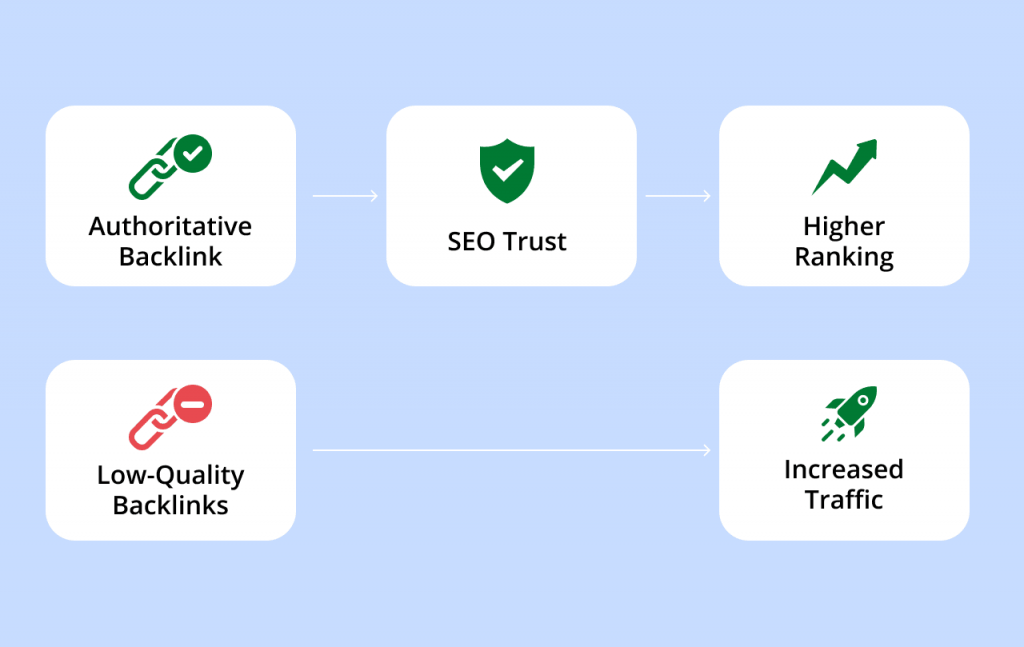
Authority and Trust Signals
Websites with Domain Authority scores above 60 or 70 are reliable sources. Authority metrics alone can be misleading, though. High Domain Rating scores can be manipulated through expired domains or false traffic statistics. So you should assess multiple factors like organic traffic and link growth patterns. Trust metrics are associated with how search engines see a website’s value. Sites that show Experience, Expertise, Authoritativeness, and Trustworthiness carry more weight in search rankings.
Natural Link Placement
Links placed within the article body text hold more ranking power than those in footers or sidebars. Editorial links appear where they support claims and provide value to readers. They don’t appear in author bios or separate sections. Google sees contextually embedded links as genuine editorial endorsements rather than manufactured signals.
Relevant Traffic Potential
Strong backlinks drive qualified referral traffic from audiences already interested in your niche. Credible sites that link to your content expose your brand to broader and highly engaged audiences. This traffic often converts better because visitors arrive through relevant platforms.
Editorial Value and Context
Editorial backlinks represent independent publishers who see your content as reference-worthy. These links come from journalists or bloggers with no connection to your brand. Publishers place them to improve their own content, not to promote your site. Search engines view this independent validation as a high-trust signal.
Quick Tools and Methods to Check Your Backlinks
Checking your backlinks regularly helps you distinguish bad backlinks from strong backlinks before they affect rankings. Several tools make this process quick and available.
Free Backlink Checkers You Can Use Now
Google Search Console remains the most reliable free option and shows backlinks straight from Google’s index. Go to the Links section to view external links, top linking sites and anchor text used by other websites. Semrush offers 10 free backlink checks daily through its Backlink Analytics tool. It displays referring domains and authority metrics. Ahrefs provides a free backlink checker updated every 15 minutes, with access to their database of over 25 trillion known links. Enter your domain as .domain.com/ to capture all backlinks, including subdomains.
Reading Your Backlink Report
Your backlink report displays several metrics for evaluating link quality. Authority Score represents the trust level of linking websites. Total Referring Domains shows unique sites pointing to you. The Follow column suggests whether links pass ranking power, with green signals showing beneficial dofollow links and grey signals suggesting nofollow attributes with minimal ranking effect. Check anchor text to understand how sites describe your content. Spam Score helps identify potentially harmful links that require further review.
When to Take Action
Take action right away when Google Search Console shows manual penalties under Security and Manual Actions. Review links with toxicity scores above your baseline, though high scores alone do not warrant disavowing. Remove or disavow links only when you have considerable spammy links that caused or will likely cause manual actions.
Conclusion
You now have the knowledge to distinguish bad backlinks from strong backlinks and protect your site’s rankings. The quality of your backlink profile affects your search visibility, so regular audits matter.The free tools mentioned above will help you check your backlinks. Earn editorial links from relevant, authoritative sources rather than chasing quantity. Spot toxic patterns and take action, but don’t panic over every low-quality link. Monitor your profile and stay proactive. Your backlinks strategy will strengthen over time.
Key Takeaways
Understanding the difference between bad and strong backlinks is crucial for maintaining healthy search rankings and avoiding Google penalties.
- Check relevance first: Bad backlinks come from unrelated industries (gambling, adult content, foreign pharmacy sites), while strong backlinks originate from topically relevant sources in your niche.
- Examine link placement: Editorial backlinks within article content carry more ranking power than footer, sidebar, or directory-style links that appear manipulative.
- Monitor anchor text patterns: Over-optimised exact-match keywords signal manipulation; natural distribution should be 50% branded, 25% topic-related, and only 10% target keywords.
- Use free tools regularly: Google Search Console, Semrush (10 daily checks), and Ahrefs provide essential backlink data to identify toxic links before they harm rankings.
- Focus on editorial value: Strong backlinks come from independent publishers who link to your content because it genuinely improves their articles, not through paid arrangements.
Remember that 70% of ranking ability comes from backlink quality, making regular audits essential for long-term SEO success. Quality always trumps quantity in building sustainable search visibility.
FAQs
Q1. What are the main signs that indicate a backlink is toxic or harmful? Toxic backlinks typically come from websites with low-quality or auto-generated content, excessive advertisements and pop-ups, suspicious domain names, and poor user experience. Additionally, spammy sites often have unusual backlink profiles, lack transparency about ownership, and may trigger unsafe browsing warnings from security tools.
Q2. What criteria should I use to evaluate backlink quality? You should evaluate backlinks based on five key criteria: anchor text relevance, the quality and relevance of the linking page’s content, the overall quality and relevance of the linking domain, the IP address diversity, and the location of the link on the page. Links embedded naturally within editorial content carry more weight than those in footers or sidebars.
Q3. How can I find toxic backlinks pointing to my website? Use Google Search Console to review your “Top linking sites” and “Top linking pages” sections. Examine all pages that backlink to your site and identify those that appear irrelevant, spammy, or come from low-quality domains. Look for patterns and clusters of suspicious links, as these are more problematic than isolated instances.
Q4. What makes a backlink “good” versus “bad” for SEO purposes? Good backlinks come from reputable, relevant websites with high authority and are placed naturally within quality content. Bad backlinks originate from unrelated industries, spam sites, or manipulative link schemes. Good links use varied, natural anchor text and provide genuine editorial value. In contrast, bad links often feature over-optimised keywords and appear in low-value placements.
Q5. Should I remove every low-quality backlink I find? No, you should only take action to remove or disavow links when you have a considerable number of spammy links that have caused or will likely cause manual penalties from Google. A few low-quality backlinks won’t necessarily harm your site, so focus on addressing significant toxic patterns rather than every single questionable link.