


Want to know how becoming skilled at E-E-A-T in SEO could give your small business an edge over bigger competitors? E-E-A-T stands for Experience, Expertise, Authoritativeness, and Trustworthiness. Google uses this core framework to review content quality and credibility. Quality evaluators at Google give higher scores to pages that show strong E-E-A-T consistently.
Google made a significant update to this framework in December 2022 by adding the extra ‘E’ for Experience. This change shows how first-hand knowledge matters more in content creation. Local businesses now have a significant advantage because they can show ground expertise that sets them apart from generic, AI-generated content. Small business owners can compete with larger companies online by focusing on these four elements. Many find it challenging to work with the newest part of E-E-A-T the second E for Experience.
This piece shows you practical ways to improve each part of E-E-A-T for your small business website. You’ll learn to showcase your hands-on Experience and build absolute trust with your audience. These strategies will help your SEO efforts line up with Google’s quality guidelines and boost your visibility where it counts most.

Understanding E-E-A-T and Why It Matters
Small businesses that want to grow online need to understand how Google evaluates quality. E-E-A-T is the lifeblood of how search engines decide which content deserves to be seen.
What is E-E-A-T in SEO?
E-E-A-T means Experience, Expertise, Authoritativeness, and Trustworthiness, Google uses this framework to assess content quality across the web. Some people might tell you E-E-A-T directly affects rankings, but it doesn’t. Google’s quality raters use these guidelines to assess search results and give feedback about algorithm changes.
Google uses this framework as a quality control checklist to decide which content should appear first in search results. Their automated systems look for signals that show these four qualities in different ways. The framework isn’t new. It started as E-A-T, but Google added the extra “E” for Experience in December 2022. They realised first-hand Experience makes content better.
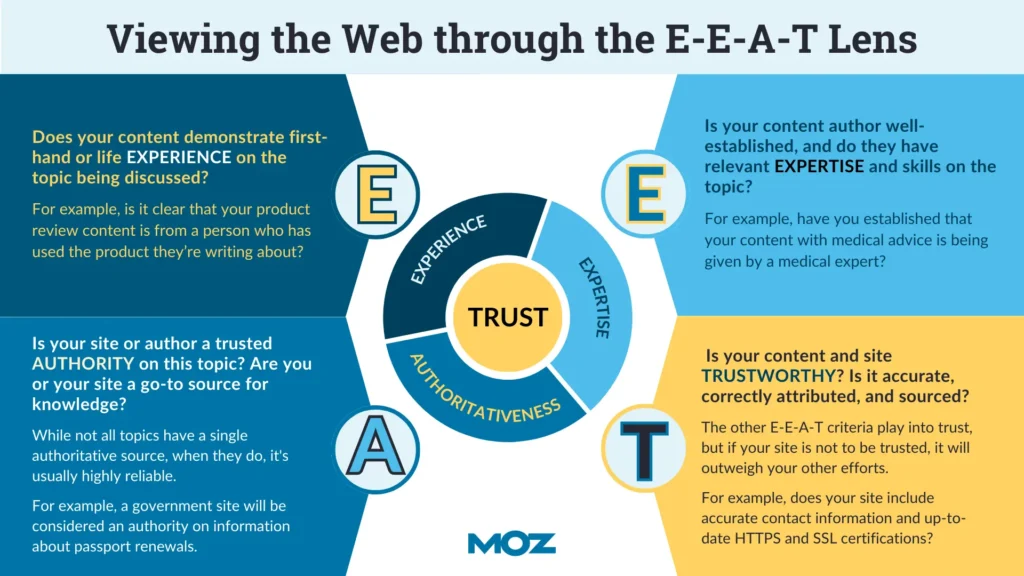
E-E-A-T complete form and its role in Google’s guidelines
Let’s break down what E-E-A-T means and how Google uses it:
- Experience: Shows you know what you’re talking about through case studies, personal stories, and hands-on involvement.
- Expertise: Proves you have the right qualifications or knowledge, especially for YMYL (Your Money Your Life) topics about health, money, or safety.
- Authoritativeness: Shows you’re a trusted voice in your field through backlinks, mentions, and industry recognition.
- Trustworthiness: Builds confidence through transparency, security, clear policies, and accurate information, Google says this matters most.
Trust stands out as the key element. The other three parts help build trust with users and search engines. Google tells its quality raters to look at all these elements when they check content quality. YMYL topics need even stronger E-E-A-T signals. These topics can affect someone’s health, money, safety, or well-being. You must show all four E-E-A-T elements clearly when writing about these sensitive subjects.
Why small businesses should care about E-E-A-T
Don’t think E-E-A-T only matters for big brands. Small companies can beat larger competitors by focusing on these principles. Google uses E-E-A-T signals to judge your site’s quality and relevance. Content that follows E-E-A-T principles ranks better in search results, especially for tough keywords. Poor E-E-A-T can hurt your visibility, no matter what other SEO work you do. E-E-A-T builds real credibility with your audience. People trust brands that show reliability and expertise. This trust shows up in better engagement, people spend more time on your pages, share your content, and come back often.
Local businesses have an edge with the “Experience” part. You can show your expertise through customer stories, case studies, and content that proves your local knowledge. People connect better with this authentic local Experience than generic content from big corporations. E-E-A-T isn’t just about making Google happy, it helps you connect with potential customers. Small businesses that show these qualities build trust that sets them apart and helps them grow. Create high-quality content that shows your real-life Experience, expertise, authority, and trustworthiness. This matches what Google wants to see in search results and helps your business show up where it counts.
Experience: Showcasing Real-World Involvement
Google’s E-E-A-T framework places Experience as a vital factor for small business SEO success. The first ‘E’ shows whether content creators have direct involvement with their topics. Google’s updated Search Quality Rater Guidelines make this clear, they look at the content creator’s first-hand or life Experience with the topic.

How to demonstrate first-hand Experience in your content
You don’t need complex strategies to show your hands-on Experience. Start by adding detailed descriptions of your content creation process. Tell readers how you researched, tested, or developed your products, services, or techniques. This helps them see your direct connection to what you’re talking about. Next, add phrases like “in my experience” or “we’ve found” where they fit naturally. Make sure these claims come from real involvement. Google asks its quality raters to check if content shows expertise from actual product use, service delivery, or place visits.
Your site needs sections that highlight your background. Many small businesses forget to build complete “About” pages that tell their story, list qualifications, and show hands-on Experience. These pages build trust with users and search engines alike. You should also explain how you gathered information for each piece of content. Google points out that readers find it helpful to know the content creation process. This becomes extra important when you discuss products or services where customers need to trust your recommendations.
Using case studies, photos, and personal stories
Visual proof makes your E-E-A-T signals stronger. Real photos of people using products or delivering services work better than stock images. To name just one example, show someone using your product in real life instead of just displaying it.
Case studies prove your Experience better than general claims. The best case studies include:
- Specific challenges you encountered
- Your unique approach to solving problems
- Measurable results with concrete data
- Personal insights gained from the process
Stories and examples make your content more human and show real involvement. These stories help readers connect emotionally while showing Google that your content comes from Experience, not just research. User content adds to your experience signals. Customer reviews, comments, and feedback create a wider range of experiences about your business. Yes, it is worth noting that Google now shows more user content from forums like Reddit because these threads often contain real first-hand experiences.
Why Experience matters more in the AI content era
Showing real Experience has become more critical with tools like ChatGPT. AI-generated content lacks first-hand Experience, so your real-world involvement gives you an edge that AI cannot copy. Google’s focus on Experience fights back against generic AI-written content. Their guidelines now state that content showing real-world Experience or insight builds more credibility and reader interest. This change gives small businesses with real expertise a clear advantage.
This authenticity gap grows when we look at AI’s role in content creation. AI helps with research and drafting, but can’t replace human Experience. Small businesses should use AI to support and improve human-created content rather than letting it take over completely. From an SEO view, experience-based content keeps readers on your page longer and converts better. These engagement metrics tell search engines your content has value. They show that your audience finds your experience-based content truly helpful. The digital world now overflows with AI-generated material. Your authentic voice, Experience, and expertise stand out to both users and search algorithms, who notice and reward authentic content.
Expertise: Proving You Know Your Stuff
Professional knowledge and qualifications form the core of expertise in the E-E-A-T framework, unlike hands-on Experience. Google looks closely at whether “written or reviewed by an expert or enthusiast who demonstrably knows the topic well”. Small business owners need solid proof of their knowledge and training to establish expertise.

Highlighting credentials and qualifications
Your formal qualifications send strong signals of expertise to Google and your audience. Professional certifications, academic achievements, and industry-specific training add to your noticed knowledge level. Research shows employees with certifications earn more than those without them. These credentials become especially important when small businesses create content about Your Money, Your Life (YMYL) topics that affect people’s health, happiness, financial stability, or safety.
Your practical industry experience and specific skills matter beyond formal education. Google’s quality raters assess expertise based on “professional qualifications, years of experience, certifications, and specific areas of expertise”. Getting relevant industry certifications can boost your professional profile if you lack formal credentials. SEO certifications, to name just one example, can improve your credibility with potential employers and clients. Real-world knowledge can prove expertise for specific topics. Your content’s quality and accuracy shine through when you write about subjects you know well.
Creating expert bios and author pages
Well-laid-out author profiles improve credibility by showing readers they get information from qualified experts. Each piece of content should showcase the author’s expertise and background. Standalone author profile pages are crucial to strengthen your website’s E-E-A-T signals. These pages should include: Your professional qualifications, certifications, and specific areas of expertiseLinks to your professional achievements, published works, and industry contributions clear explanation of your values and what drives your work professional photo and contact information Author bios should answer four key questions: Who are you? What have you done? When do you do? What can you do?. Your unique strengths make you stand out, skills, awards, or projects that made a difference. Your bio tells your story with clarity, confidence, and purpose.
Using expert reviews and quotes in your content
Expert reviews and quotes add strength to your content’s credibility, especially when discussing topics outside your expertise. Many sites use expert reviews when writers lack specific training or education. This method helps establish expertise even when the leading content creator isn’t the subject matter expert. Expert quotes need clear introductions with names and credentials. Place these quotes strategically, add an example quote early to grab attention and support points with current statistics. Expert contributions often lead to backlinks from contributors’ websites, spread across professional networks, and build overall topical authority.
Your contributors deserve visibility through their photo, name, designation, and a do-follow link to their website or social profile. This creates mutual benefits—you gain credibility. At the same time, they receive recognition, often leading to natural promotion and backlinks to your content.These expertise-building approaches strengthen a vital component of Google’s E-E-A-T framework while building stronger connections with your audience.
Authoritativeness: Becoming a Recognised Voice
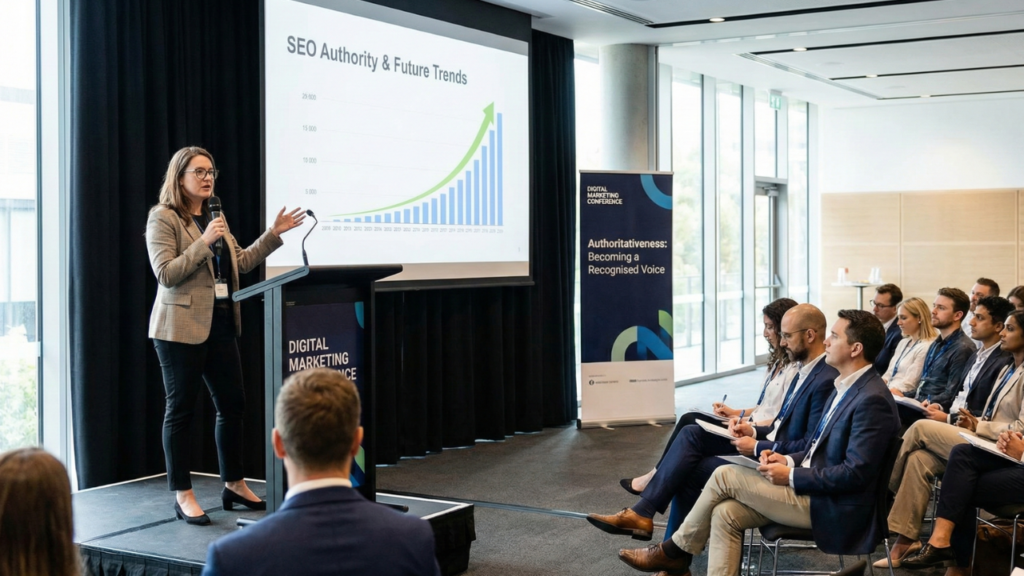
Google’s E-E-A-T framework defines authoritativeness as your ability to become a trusted voice in your industry. Search engines now value websites that serve as go-to resources for specific topics. Small businesses can’t build this trust overnight, but they can take strategic steps to establish their authority.
How to earn mentions and backlinks
Backlinks are still one of the best ways to boost your online visibility and authority. They work like votes of confidence from other websites to yours, showing Google your content matters. These links matter not just for traditional search but also for AI platforms like ChatGPT and Google’s AI Overviews, which learn about your brand through online mentions. Quality beats quantity every time in backlink building. A single link from a respected site can bring more SEO value than dozens of links from weak sources. Your best bet is to aim for backlinks from sites that have domain authority scores above 30 and relate to your industry.
Resource pages give small businesses great chances to shine. These curated lists often appear on educational sites, industry groups, or respected blogs. Getting your name on these pages puts you next to trusted sources and helps establish you as an authority. You can also build authority by offering expert quotes or insights to journalists and content creators. Contributing valuable knowledge to respected publications shows your expertise and creates relevant mentions that link your brand to specific topics. This works because you appear in trusted publications right next to the topics you want to own.
Building topical authority through content depth
Topical authority shows how much Google trusts your site to cover a subject and its related subtopics fully. Unlike general domain authority, it focuses on becoming an expert in specific areas through detailed content coverage. Your content strategy needs both width and depth to build topical authority. Width means covering all key subtopics and common questions. In contrast, depth means giving thorough, helpful answers, not just scratching the surface.
Detailed guides that serve as reliable sources naturally attract backlinks when other creators use them as references. Original research also provides citable information, including industry surveys, data analysis, trend studies, and performance measures. Internal linking helps establish your topical authority. When your content pieces connect through clear anchor text, Google sees you’ve built a structured topic ecosystem instead of random posts. This internal structure helps search engines find your most important content, especially your core pages.
Leveraging digital PR and guest posts
Digital PR gives small businesses a powerful way to build authority. Creating campaigns that establish you as a leading voice in your sector can earn you high-quality links while strengthening your E-E-A-T signals. Analytical campaigns work great for positioning yourself as an authority in your niche. Brand announcements create more opportunities to build authority. Sharing essential updates about your business, like product launches or partnerships, attracts media coverage that boosts your industry standing. Local media often covers these stories, giving you quality brand-focused backlinks.
Guest posting works well with the right approach. Instead of seeing it as just link building, treat it as a way to expand your brand’s presence meaningfully. You’re using guest content to join relevant conversations across the web. Look for guest posting chances on sites that match your niche and have engaged readers. Personal outreach emails that show the value of your content improve your acceptance odds. Remember that successful guest posting isn’t about traffic or keywords, relevance beats reach, trust tops metrics, and citations matter more than backlinks. These authority-building strategies help small businesses develop the “A” in E-E-A-T, creating a strong foundation for better visibility and credibility in their target markets.
Trustworthiness: Building Confidence with Users and Google
Trust is the cornerstone of Google’s E-E-A-T framework and matters more than all other elements. Google states that “untrustworthy pages have low E-E-A-T, no matter how Experienced, Expert, or Authoritative they may seem”.

Website security and transparency basics
A secure website sends strong trust signals to users and search engines. Your site needs an SSL certificate to protect customer data from hackers during transmission. The site should look professional with working links. Avoid using placeholder text or images that might make your website look incomplete. Being open about your business operations helps build trust with potential customers. A detailed “About” page should tell your business’s story and values. On top of that, it helps to state how you gather information for your content. This shows readers your content creation process and proves authenticity.
Managing reviews and customer feedback
Today’s word-of-mouth comes in the form of online reviews. These trust signals can affect your local SEO rankings. Google uses them to determine if your business is relevant and reliable, which could improve your position in local search results. Your responses to both good and bad reviews show you care about customer satisfaction. Keep your interactions with reviewers professional and solution-focused. Bad reviews need constructive solutions, and you should be willing to fix problems. This approach fixes specific issues and shows your commitment to getting better. Make authenticity your priority by welcoming honest feedback, including negative comments. Different opinions paint a real picture of your business and build genuine trust with future customers.
Clear contact info, policies, and business details
Put your contact information where people can easily find it, especially on a dedicated contact page with multiple ways to reach you. This shows customers you stand behind what you offer. Make your privacy policy, terms of service, and business practices easy to understand. Tell visitors how you protect their personal information. These elements of transparency tell Google your business deserves good rankings. Your business details should match everywhere online. Names, addresses, phone numbers and other important information need to stay consistent across all platforms where your business appears.
How to Implement E-E-A-T for Your Business
Your small business website needs practical steps to put E-E-A-T principles into action. These four key strategies work together to boost your site’s quality signals and turn theory into practice.
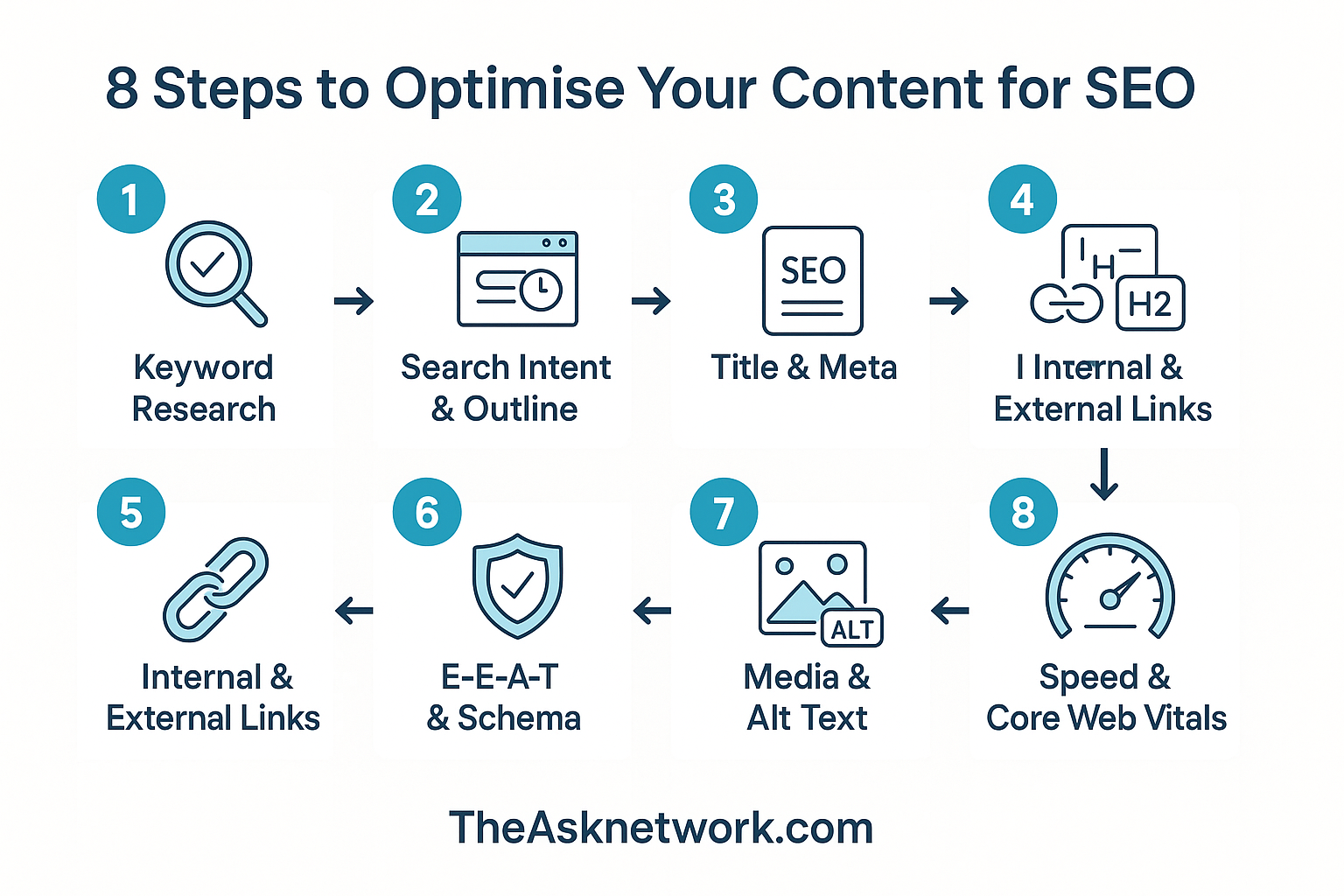
Audit your current content for E-E-A-T signals.
Start with a detailed E-E-A-T audit to spot your website’s strengths and gaps. Your key pages should have accurate, current, and helpful information. Look for ways to show your hands-on knowledge and expertise better. Make sure your content has clear author attribution with linked bios that show their credentials. Basic trust elements like SSL certificates, privacy policies, and precise contact details will establish your site’s trustworthiness.
Use schema markup and structured data.
Schema markup helps search engines better understand your content. This structured data tells search engines what your content means, beyond just the words on the page. Exemplary schema implementation can improve your search listings by a lot. Your results can show extra details like star ratings, pricing, or FAQs. These rich snippets make your listings more helpful and get more clicks.
Encourage user-generated content and testimonials.
User-generated content directly boosts your E-E-A-T by adding genuine authenticity to your website. Customer reviews, photos, and videos show real-life experiences with your brand. These prove to new visitors that others have tried and tested your products. You can get more Google reviews or testimonials by offering small perks like discounts or loyalty points. Quick links to review platforms make it easier for customers to share their thoughts.
Monitor brand mentions and sentiment.
Brand mentions show social proof to search engines and potential customers alike. Regular tracking helps you measure your impact and find new opportunities. Tools like Google Alerts, Mention, and Brandwatch help you track references on websites, blogs, forums and social platforms. Quick and professional responses to all feedback show you care and build trust, signals that boost your visibility.
Build authority. Earn trust. Rank sustainably. Let The ASK Network help you implement E-E-A-T-driven SEO strategies that actually convert.
Conclusion
Small businesses can gain a real competitive edge against larger corporations and AI-generated content by becoming skilled at E-E-A-T principles. This guide has shown how Experience proves your real-life involvement, while expertise validates your professional knowledge and qualifications. It also shows how authoritativeness makes your business a recognised voice in your industry, and trustworthiness builds vital confidence with users and search engines. Small businesses benefit from Google’s addition of the second “E” for Experience. They can show authentic, hands-on knowledge. Without doubt, this gives you an advantage over generic, AI-generated content that lacks real-life insights. Your practical Experience with local customers becomes a powerful differentiator that bigger competitors often can’t match.
Each E-E-A-T component needs careful thought to implement. You should audit your current content and strengthen weak areas through case studies, expert bios, quality backlinks, and transparent business practices. Trust is the foundation of all other elements. Without it, even the most experienced or authoritative content will struggle to rank well. E-E-A-T isn’t just an SEO requirement for small businesses. It’s a business philosophy that lines up with quality service. Your SEO results will follow naturally when you show Experience, display expertise, build authority, and earn trust. Users will stay longer on your pages, connect more with your content, and convert at higher rates.
Your focus should be on creating authentic content that shows your unique strengths instead of chasing algorithm changes. Your small business has something valuable, genuine Experience and expertise that AI can’t copy. This authenticity, combined with clever use of E-E-A-T principles, will help you build lasting rankings while creating meaningful connections with your target audience. The digital world keeps changing, yet E-E-A-T remains a stable framework that rewards businesses providing real value. Your small business can achieve long-term SEO success based on quality rather than shortcuts by applying these principles across your digital presence. Best of all, you build trust that turns casual visitors into loyal customers who choose your business because they recognise your authentic expertise.
Key Takeaways
Master Google’s E-E-A-T framework to compete effectively against larger competitors and AI-generated content through authentic expertise and real-world Experience.
- Experience beats AI content: Showcase first-hand involvement through case studies, original photos, and personal stories to outrank generic AI-generated material.
- Build trust through transparency: Display SSL certificates, clear contact information, privacy policies, and professional author bios to establish credibility.
- Earn authority systematically: Focus on quality backlinks from relevant sites, create comprehensive topic coverage, and leverage digital PR opportunities.
- Audit and implement strategically: Review current content for E-E-A-T signals, use schema markup, and actively encourage customer testimonials and reviews.
- Leverage your local advantage: Small businesses can demonstrate authentic community expertise that larger corporations struggle to replicate effectively.
The beauty of E-E-A-T lies in its alignment with genuine business quality—when you authentically demonstrate Experience, expertise, authority, and trustworthiness, improved search rankings naturally follow. This framework rewards businesses that provide real value rather than those chasing algorithm shortcuts, making it particularly powerful for small businesses with genuine expertise to showcase.
FAQs
Q1. How can small businesses effectively implement E-E-A-T principles in their SEO strategy? Small businesses can implement E-E-A-T by showcasing real-world Experience through case studies and personal stories, highlighting expertise with professional credentials, building authority through quality backlinks and comprehensive content, and establishing trust with transparent business practices and clear policies.
Q2. What is the significance of the ‘Experience’ component in Google’s updated E-E-A-T framework? The ‘Experience’ component emphasises the importance of demonstrating first-hand knowledge and practical involvement with the subject matter. This addition gives small businesses with genuine local expertise an advantage over larger competitors and AI-generated content.
Q3. How can businesses build authoritativeness in their niche? Businesses can build authoritativeness by earning quality backlinks from relevant websites, creating in-depth content that covers topics comprehensively, leveraging digital PR opportunities, and consistently producing valuable, expert-level content in their specific industry.
Q4. What role do user reviews and testimonials play in E-E-A-T? User reviews and testimonials are crucial for building trust and demonstrating real-world Experience. They serve as social proof, helping to establish credibility with both potential customers and search engines, particularly for local SEO.
Q5. How often should businesses audit their content for E-E-A-T signals? While there’s no set frequency, it’s advisable to conduct regular E-E-A-T audits, perhaps quarterly or biannually. This involves reviewing content for accuracy, updating author bios, ensuring technical trust elements are in place, and identifying opportunities to demonstrate expertise and Experience better.